
St George District Cricket Club - 1969-70: From sorrow to triumph
The saddest of beginnings was perhaps the inspiration for a second consecutive premiership.
Just one match into the season, Billy and Nell Watson’s loss of their third and youngest child, son Brook, rocked the whole club. Billy himself was inconsolable and immediately gave up the game for the rest of that season and the whole of the next.
As a person he was missed, as a player doubly so. Several changes were tried and the best proved to be the club newcomer David Paull, who played a critical innings as the team clinched the premiership. David, though, was just one of three people to join the club with no great expectations, but who played critical roles.
The second was Trevor Osborne, who transferred from Sydney University where he had built a very promising reputation as a fast bowler and turned an excellent St George attack into a lethal one.
The third newcomer was Ken Ferguson who’d transferred from Wests with no fanfare. He was happy to play seconds. Circumstances caused his promotions for the semi-final in which he played a match-wining 65, 48 of which came with No 11 Osborne. Ken also bowled quickish fast-mediums very intelligently. Then in the final when quick runs were needed before rain to ensure victory rather than a draw and no premiership, Ken rose to the challenge. Work took him to Perth the next year and no one at St George was surprised to hear that he went very close to state selection – nor that in his marketing business he devised the Western Warriors trademark, name and modus operandi.
Why did they come? All three independently said that they wanted to join a quality club. The term “culture” was unheard of then, but it certainly existed. And while Ferguson was to leave immediately through work, Paull was to become an outstanding second grade captain, and Osborne was to become club secretary and delegate to the NSWCA.
Giving all three of them room to settle were Brian Booth with 704 runs at 44, Warren Saunders with 576 runs, John Martin with 42 wickets and Kerry O’Keeffe (in his limited appearances) with 30 wickets at an average just under 12.
All of which led to another fine season, and another first grade premiership.
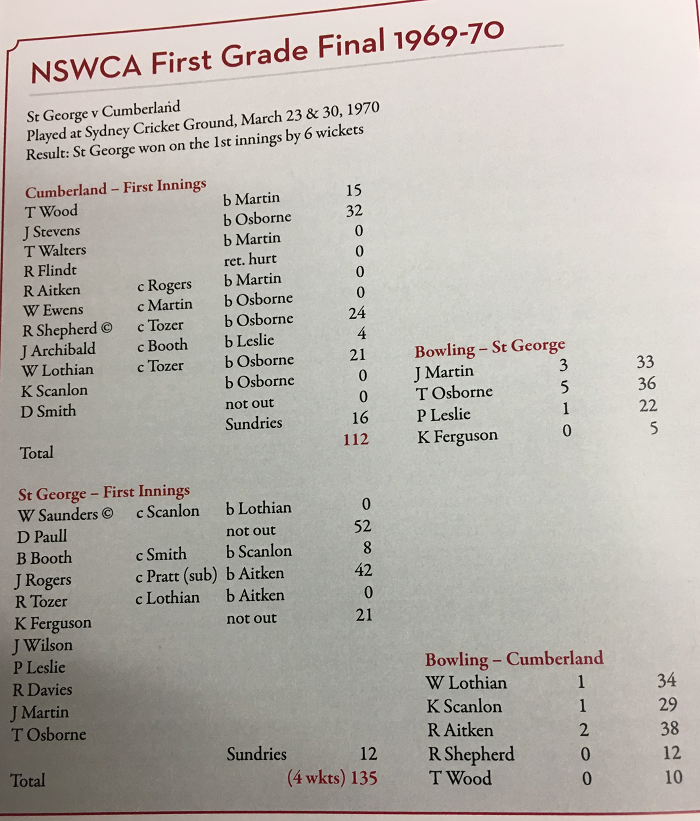
Clear leaders until the last few rounds, the club was pipped as minor premiers and scraped home against Wests in the semi-final to face minor premiers Cumberland in the final at the SCG.
A damp and under-prepared pitch greeted both sides on arrival. Sent in, Cumberland’s openers made good progress to 30. Pace bowler John Martin had been chosen despite feeling unwell and had handed the ball back to his captain after just three overs. Several overs later Martin asked to bowl again and this time destroyed Cumberland in a fiery display, picking up three quick wickets and forcing a fourth to retire hurt with a broken arm – batsman Nos 3 to 6 all recording ducks. Trevor Osborne then finished off the tail with 5-36 keeping Cumberland to 112.
At 2-11 with Saunders and Booth both out, St George were in trouble, but Rogers and Paul counterattacked, and when Rogers was out for 42 followed by Tozer for a duck, Ferguson blasted a quickfire 21 to ensure a first innings lead before the end of day one. With play washed out the next weekend, St George claimed its second consecutive premiership.
Capping a fine season for the club was the achievement of having four players feature in state cricket. Unfortunately, Kerry O’Keeffe was the only one still playing at season’s end.
Following his excellent debut season, John Wilson had a horror run and was discarded after just three games. One the back of a good start to the season John Rogers was 12th man for the first six games, then dropped for one and then chosen to play against WA in Perth after team captain John Benaud was suspended for wearing the new half-spiked cricket boots which drew the ire of NSWCA. A sprained ankle on the second morning ruled Rogers out of the final game of the season in Adelaide. John Martin was recalled for one game and again discarded. Kerry O’Keeffe meanwhile, continued to make good progress, and another St George Test players began to look a possibility.
This story was originally published in the book written by John Rogers titled “Mr St George” - Warren Saunders and the culture of success he inspired.